
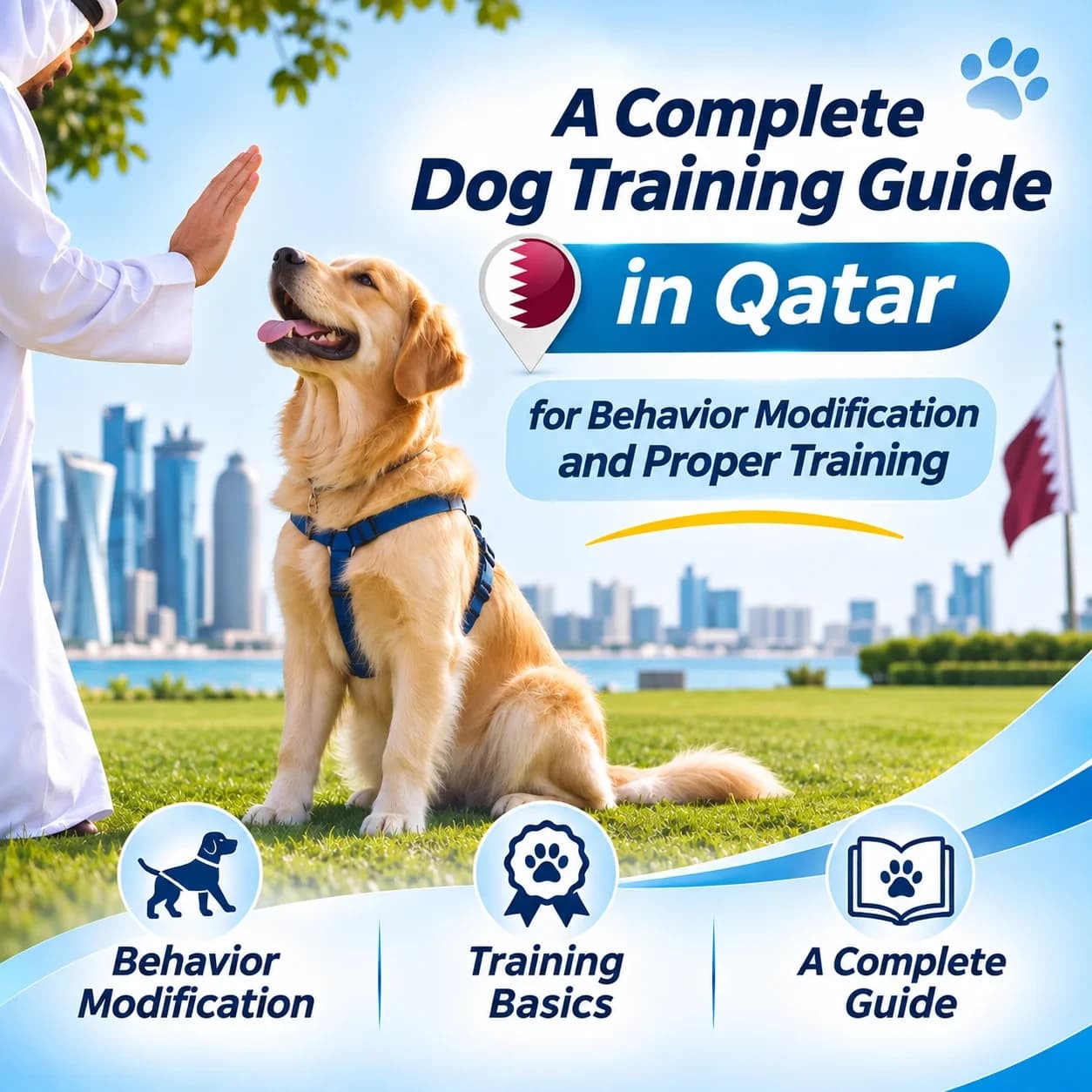
Training a dog requires patience, consistency, and an understanding of the reasons behind its behavior. Some adult dogs may develop excessive barking, leash pulling, fear of strangers, difficulty staying alone, or other behavioral challenges. These issues can often be addressed through a suitable training plan based on positive reinforcement and gradual learning.
In Qatar, dog owners should also consider the hot climate when planning outdoor activities and training sessions. Successful behavior modification starts with identifying the problem, understanding its triggers, and teaching the dog more appropriate ways to respond.
Has your dog's behavior suddenly changed? There may be an underlying health issue. Contact the Elite veterinary team:
Adult Dog Training and Behavior Modification
Adult dogs can learn new commands and develop better habits, even if they did not receive basic training as puppies. However, the first step is to understand whether the behavior is simply a training issue or whether it may be linked to fear, pain, anxiety, or another health concern.
Common behavioral problems include:
Excessive barking: This may be triggered by fear, boredom, unfamiliar sounds, or movement outside the home.
Leash pulling: Some dogs pull because they are excited or have not learned how to walk calmly on a leash.
Jumping on people: This behavior may be an attempt to seek attention or express excitement.
Biting and inappropriate chewing: These behaviors may be related to boredom, stress, or a lack of suitable activities.
Fear of strangers or other dogs: This requires gradual, controlled exposure without forcing the dog to approach something it fears.
Aggressive behavior: This requires professional assessment and a structured plan that considers the safety of the dog, people, and other animals.
Avoid shouting, hitting, or physically punishing your dog. Punishment may increase fear and stress without teaching the dog what behavior you expect instead.
How to Modify Your Dog's Behavior Properly
Start by observing when the unwanted behavior occurs. Note what happens immediately before it, where it takes place, and how your dog responds afterward. These observations can help identify triggers rather than simply reacting to the symptoms.
Follow these steps:
Identify the target behavior: Focus on one issue at a time, such as leash pulling or barking when someone rings the doorbell.
Recognize the trigger: Observe the people, sounds, or situations that happen before the behavior.
Reduce exposure to difficult situations: Use a safe distance or an appropriate barrier if your dog becomes stressed around other dogs.
Teach an alternative behavior: For example, teach your dog to sit or look at you when a trigger appears.
Reward the correct response: Use small treats, toys, or praise that your dog enjoys.
Increase difficulty gradually: Do not move to crowded or distracting environments until your dog can respond reliably in a quiet setting.
If your dog attempts to bite, shows serious aggression, or experiences intense fear, do not test its reactions in situations that could put anyone at risk. Seek help from a qualified dog behavior professional and consult a veterinarian to rule out possible medical causes.
Puppy Training: Building the Right Foundation at Home
Early training helps puppies learn their names, develop appropriate toilet habits, and become more comfortable with household members, everyday sounds, and their surroundings.
Keep training sessions short and consistent, and reward desirable behavior as soon as it happens.
Puppies have different developmental needs from adult dogs. For a more detailed guide, read our dedicated article: [Dog Training for Puppies in Qatar: A Guide to the First Six Months]. Add the internal link to the previously published article dated July 8.
Teaching Your Dog Basic Commands
Basic commands improve communication between you and your dog and help you manage everyday situations. Choose a quiet location, use small treats, and keep each practice session short.
1. The "Sit" Command
Hold a small treat in front of your dog's nose.
Slowly move your hand upward and slightly backward over its head so it naturally follows the treat and lowers its hindquarters.
As soon as your dog sits, say "Sit" and reward it immediately.
Repeat several times, then gradually introduce the verbal command before using the hand movement.
2. The "Come" Command
Start at a short distance inside your home.
Say your dog's name followed by "Come" in a friendly, encouraging voice.
When your dog approaches, reward it with a treat and praise.
Gradually increase the distance, then practice in more distracting environments using a secure leash.
Avoid using the "Come" command only when you are about to punish your dog or end an enjoyable activity. You want your dog to associate coming to you with a positive experience.
3. The "Stay" Command
Ask your dog to sit first.
Say "Stay" while giving a clear hand signal.
Take one step away, then return and reward your dog if it remains in position.
Gradually increase the duration and distance. If your dog moves too early, return to an easier stage.
4. The "Leave It" Command
Place a treat inside your closed hand and show it to your dog.
Say "Leave it" and wait without pushing or pulling your dog's face.
When your dog stops trying to reach the treat, reward it with a different treat from your other hand.
Gradually practice with different objects, while keeping dangerous items out of reach.
Teaching Your Dog to Walk on a Leash Without Pulling
Start indoors or in a quiet outdoor area. Use a suitable collar or harness and a secure leash. Reward your dog whenever it walks beside you with a loose leash.
If your dog starts pulling, stop calmly and wait until it returns to you or the leash becomes loose. Then continue walking.
Avoid jerking the leash or using equipment designed to cause pain. With consistent practice, gradually introduce more distracting environments while considering your dog's ability to focus.
In Qatar, choose cooler times of the day for walks, especially during summer. Avoid strenuous exercise in hot and humid weather, provide access to water and shade, and watch for excessive panting, weakness, vomiting, or unsteadiness. These may be signs of heat-related illness requiring urgent veterinary attention.
Managing Barking, Biting, and Fear
Barking does not automatically mean that a dog is poorly trained. It may be a way of expressing fear, discomfort, boredom, or alertness to something unfamiliar.
Try to identify the reason behind the barking, reduce unnecessary triggers, and reward calm behavior instead of shouting at your dog.
Biting should also be assessed according to the situation. Playful mouthing is different from biting caused by fear, pain, or resource guarding. Avoid physical punishment, and never try to forcibly remove an object from your dog's mouth if doing so could result in injury.
If your dog shows signs of fear, such as hiding, trembling, or attempting to escape, give it space and avoid forcing interactions.
Repeated biting or aggressive behavior requires professional assessment and appropriate safety precautions until a suitable behavior plan is established.
How to Manage Separation Anxiety in Dogs
Separation anxiety may occur when a dog is left alone. Common signs include:
Persistent barking or howling.
Destructive behavior around the home.
Urinating or defecating indoors.
Attempts to escape.
Restlessness or distress when the owner prepares to leave.
To help your dog:
Begin with very short periods of separation and gradually increase them according to your dog's response.
Provide a comfortable resting area and suitable enrichment activities.
Avoid punishing your dog for damage or mess discovered when you return.
Monitor your dog's behavior while you are away, using a home camera if possible.
Seek veterinary or behavioral support if the symptoms are severe or persistent.
Separation-related problems may require a gradual behavior modification plan. Leaving a distressed dog alone for extended periods in the hope that it will eventually get used to it is not a suitable approach.
Crate Training for Dogs
A crate can provide a comfortable and secure resting space when introduced properly. It should never be used as punishment or as a way to confine a dog for excessive periods.
To introduce crate training:
Choose a crate that allows your dog to stand, turn around, and lie down comfortably.
Leave the door open and place comfortable bedding and treats inside.
Encourage your dog to enter and leave freely without forcing it.
Offer meals near the crate, then gradually place them inside when your dog becomes comfortable.
Begin closing the door for a few seconds while staying nearby, then gradually increase the duration.
Stop or make the exercise easier if your dog shows clear signs of fear or distress.
Never leave your dog inside a crate for excessive periods. Crate time does not replace daily walks, exercise, play, and social interaction.
How Much Does Dog Training Cost in Qatar?
Dog training costs in Qatar vary depending on the dog's needs and the type of program offered by the trainer. There is no single price that applies to every dog. Basic obedience training is different from a specialized behavior modification program for fear, aggression, or separation anxiety.
Several factors can affect the cost:
Type of program: Basic obedience training may differ in price from specialized behavior modification.
Number of sessions: Some dogs may need only a few sessions, while ongoing behavioral problems may require a longer program.
Training location: In-home training arrangements may differ from sessions at a dedicated training center.
Trainer's experience and approach: Consider the trainer's qualifications, methods, and experience with your dog's specific needs.
Your dog's individual requirements: Age, previous training experience, and the severity of the behavior can affect the length of the program.
Before choosing a trainer, ask for a clear training plan, the expected number of sessions, whether family members will receive guidance, and how progress will be measured.
Be cautious of guaranteed results or promises to resolve complex behavioral problems very quickly.
How to Choose a Dog Trainer in Qatar
Choosing a dog trainer should not depend only on price or location. The trainer's methods, experience, and understanding of canine behavior are equally important.
Look for a professional who:
Explains the training process clearly.
Encourages family members to participate.
Uses rewards and gradual training rather than intimidation or pain.
Has experience with the specific behavior your dog displays.
Provides a clear way to monitor progress.
Ask about the trainer's qualifications and request details about the methods used during sessions.
The American Veterinary Society of Animal Behavior (AVSAB) recommends reward-based methods for dog training and behavior modification and warns against approaches based on pain, fear, or punishment. Read its official Humane Dog Training Position Statement.
Book Veterinary Care for Your Dog at Elite Pet Qatar
Good dog care begins with understanding both behavioral and health needs. If you notice a sudden change in your dog's behavior, signs of pain, or unusual fear, a veterinary checkup may be an important step before starting a training program.
Elite Veterinary Clinic is located on Al Shafi Street in Al Rayyan, Qatar, and provides veterinary examinations and medical care for pets.
Phone: +974 3042 3623
WhatsApp: Contact the Clinic
Appointments and Enquiries: Official Contact Page
Opening Hours: Saturday and Monday–Thursday: 8:00 AM–11:00 PM; Sunday: 8:00 AM–10:00 PM; Friday: 2:00 PM–10:00 PM.
Frequently Asked Questions About Dog Training and Behavior Modification
How do I teach my dog to sit?
Hold a treat in front of your dog's nose and slowly move it upward and backward over its head. As your dog naturally sits, say "Sit" and reward it immediately. Repeat the exercise in short sessions until your dog responds to the verbal command without needing the hand movement.
Can an older dog still be trained?
Yes. Older dogs can learn new commands and develop better habits. Training may take more time or require exercises adapted to their physical abilities, especially if they have pain or mobility problems. A veterinary checkup is advisable if you notice health or behavioral changes.
How many times should I train my dog each day?
You can start with short sessions of around 5–10 minutes, repeated two or three times a day depending on your dog's ability to focus. It is better to finish while your dog is still engaged than to continue until it becomes bored or stressed.
How much does a dog trainer cost in Qatar?
The cost varies depending on the type of training, number of sessions, location, trainer's experience, and complexity of the behavior. Ask for a clear training plan and a detailed cost breakdown before booking. Do not choose a trainer based on price alone.
Can aggressive behavior in dogs be modified?
Some forms of aggression can be addressed through a specialized behavior plan. However, the underlying causes and level of risk must be assessed first. Do not force your dog to face situations that cause fear. Seek help from a qualified behavior professional and consult a veterinarian to rule out medical causes.
Is reward-based dog training better than punishment?
Reward-based training encourages dogs to repeat desirable behaviors and can help build a safer, more trusting relationship. Shouting, hitting, and painful training equipment may increase fear and stress, so these methods should be avoided.
Can a dog be trained to stay home alone?
Yes. You can gradually teach your dog to stay alone by starting with very short periods of separation and increasing them slowly. Provide a safe environment and appropriate activities. If your dog shows severe distress, persistent destruction, or continuous howling, a specialized behavior plan may be needed.